


If you own a business, big or small, you’ve almost certainly heard the word “SEO” thrown around. Maybe someone told you that you need it. Maybe you’ve even tried it.
But then you heard someone say “local SEO” and thought: wait, aren’t those the same thing?
They’re not. And understanding what the difference between SEO and local SEO is could be the single most important thing you do for your business online this year. Get it wrong, and you’ll spend time and money chasing the wrong audience. Get it right, and customers who are already nearby and ready to buy will find you first.
Let’s break it all down, simply, clearly, and without unnecessary jargon.
The simple version first: what do both actually mean?
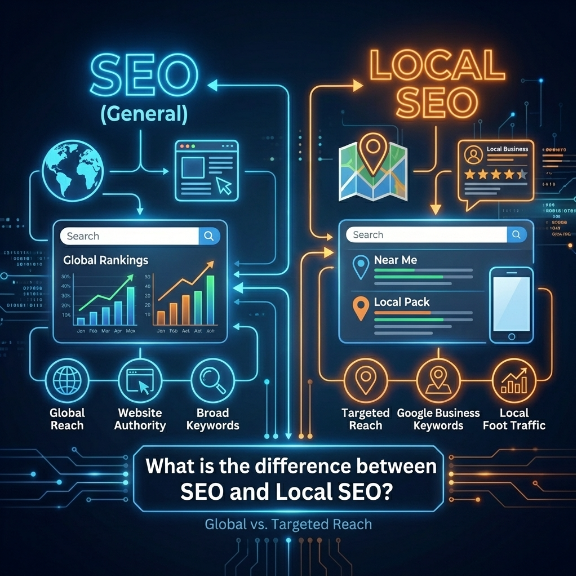
SEO (Search Engine Optimization) is the practice of making your website show up on Google and other search engines when people search for things related to your business. It doesn’t matter where those people are. Someone in Tokyo searching “best running shoes” and someone in Toronto searching the same thing both see results shaped by SEO.
Local SEO is different. It’s about making your business show up when people nearby search for something you offer right now, often on their phone. “Coffee shop near me.” “Plumber in Birmingham.” “Best dentist in Manchester.” That’s local SEO territory.
Think of it this way: Regular SEO is like putting up a billboard on a motorway — millions of people might see it, from anywhere. Local SEO is like putting up a sign at the end of your street — fewer people see it, but they’re all already close by and actually looking for what you do.
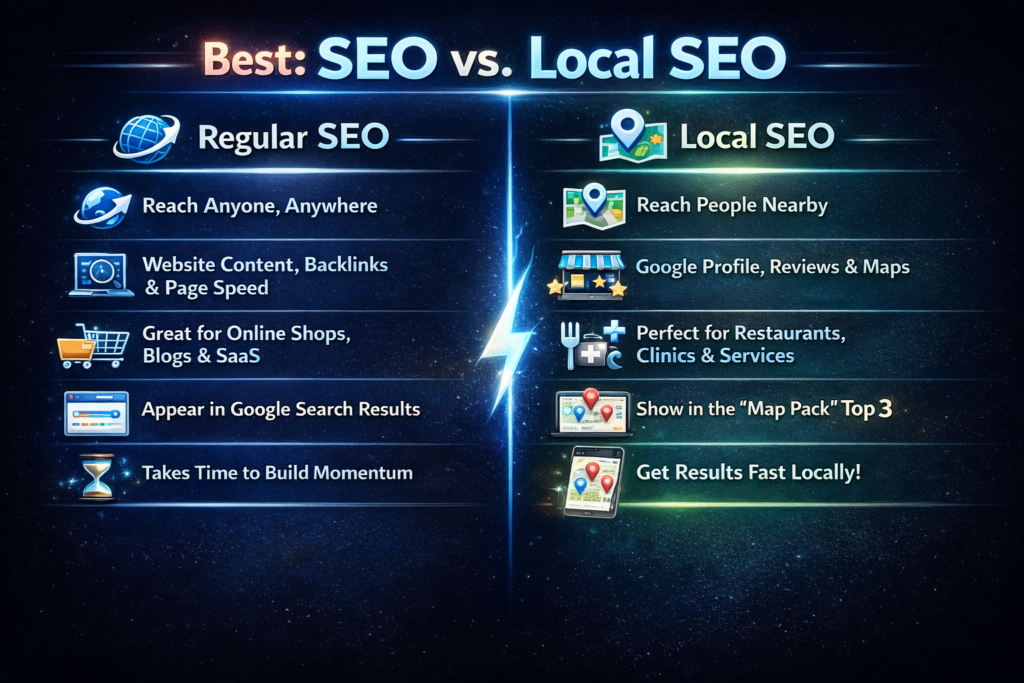
Local SEO vs SEO — a side-by-side look
When you look at local SEO vs SEO directly, the differences become very clear very quickly.
Regular SEO
Reach anyone, anywhere
- Targets national or global audiences
- Focuses on website content, backlinks, and page speed
- Best for online shops, blogs, and SaaS products
- Results appear in standard Google search listings
- Takes longer to build momentum
Local SEO
Reach people nearby
- Targets customers in a specific city, town, or area
- Focuses on Google Business Profile, reviews, and maps
- Best for restaurants, clinics, tradespeople, shops
- Results appear in the “map pack” the top 3 map results
- Can show results much faster for local searches
The core difference between SEO and local SEO comes down to this: regular SEO is about visibility across the internet, while local SEO is about visibility in your neighbourhood, town, or city.
Why local SEO has its own set of rulesWhy local SEO has its own set of rules
Local SEO isn’t just “regular SEO, but smaller.” It has its own ranking system, its own signals, and its own strategies. These are known as local SEO ranking factors, and they’re quite different from what drives national SEO performance.
The most important local SEO ranking factors include:
- Google Business Profile — This free listing is the single most powerful local SEO tool. Your name, address, phone number, opening hours, photos, and reviews all live here. If it’s incomplete or outdated, you’re invisible in local results.
- Consistency of your NAP details — NAP stands for Name, Address, Phone number. These details need to be identical everywhere online — your website, Google, Facebo
| Local Seo Ranking Factors |
Local backlinks — Links from local newspapers, community websites, or business directories in your area carry significant weight for local rankings.
ok, and directories. Any mismatch confuses Google and hurts your local ranking.
Customer reviews — The number, quality, and recency of your Google reviews directly affect where you rank locally. A business with 200 recent, positive reviews will almost always outrank a competitor with 12 old ones.
Location-specific content — Mentioning your town, city, or service area naturally throughout your website tells Google exactly who you serve.
What is local search marketing — and do you need it?
Local search marketing is the broader strategy of getting your business found by nearby customers across all digital channels, not just Google. It includes your Google Business Profile, local ads, review management, location pages on your website, and listings in local directories like Yell or Bing Places.
You need it if your business serves a physical location or a specific geographic area. It doesn’t matter whether you run a beauty salon, a law firm, a gym, or a takeaway — if people need to come to you, or if you go to them locally, local search marketing is one of the highest-return investments you can make.
“The best time to set up your local SEO was when you launched. The second-best time is today.”
How to actually improve your ranking step by step
Whether you’re starting from scratch or trying to improve existing results, these steps work for businesses of any size:
- Claim and complete your Google Business Profile. Fill in every single field. Add photos, set your hours, choose the right business categories, and write a clear description of what you do.
- Ask your happy customers for reviews. Don’t wait and hope. After a job well done, send a polite message with a direct link to your Google review page. It works.
- Check your NAP details everywhere. Google your own business name and look at every listing that appears. Make sure your name, address, and phone number match exactly on all of them.
- Create a page on your website for each location or service area you cover. A plumber in Leeds covering multiple areas should have a page for each town – not just one generic page.
- Build local links. Sponsor a local event. Get listed in your Chamber of Commerce. Write a guest post for a local news site. These links tell Google you’re genuinely part of the community.
If this feels like a lot to manage alongside running a business, working with a trusted SEO Outsourcing Company can take the technical and ongoing work off your plate entirely so you can focus on the business while experts handle your search visibility.
Don’t forget: the future of search is changing fast
Google is rolling out AI-powered summaries at the top of search results, called AI Overviews, that answer questions directly, before anyone even clicks a link. This affects both regular SEO and local SEO. Understanding How to Show Up in AI Overviews SEO is becoming essential for any business that wants to stay visible as search evolves. It requires structured, authoritative content and a clean, trustworthy website that a good Digital Marketing Agency will build into your strategy from day one.
Contact Pixel AI Marketing to schedule free consultation today.
Frequently asked questions
If I already do regular SEO, do I still need local SEO?
Yes — if you serve customers in a specific area. Regular SEO and local SEO target different types of searches and appear in different parts of Google’s results. A local bakery ranking well nationally for “artisan bread recipes” won’t necessarily show up when someone nearby searches “bakery near me.” You need both working together.
How long does local SEO take to show results?
Faster than national SEO in most cases. For less competitive local markets, you can start seeing movement in 4–8 weeks once your Google Business Profile is properly optimised and you’ve gathered some fresh reviews. Highly competitive cities or industries may take 3–6 months for consistent results.
Does my business need a physical address to do local SEO?
Not necessarily. Service-area businesses — like plumbers, cleaners, or mobile dog groomers — can set a service area on their Google Business Profile without showing a physical address. You still benefit from local SEO; you just set it up slightly differently.
What’s the “map pack” and why does everyone talk about it?
The map pack is the box of three local business results — with a map — that appears near the top of Google when someone makes a local search. It’s prime real estate. Studies consistently show that these top three spots get the majority of clicks for local searches. Getting into the map pack is the main goal of local SEO.
Can a small business compete with big brands using local SEO?
Absolutely — and this is one of local SEO’s biggest strengths. Google’s local results heavily favour proximity and relevance over brand size. A small independent café with a complete Google profile, recent reviews, and good local content can easily outrank a national chain in that specific area. Local SEO levels the playing field.
