


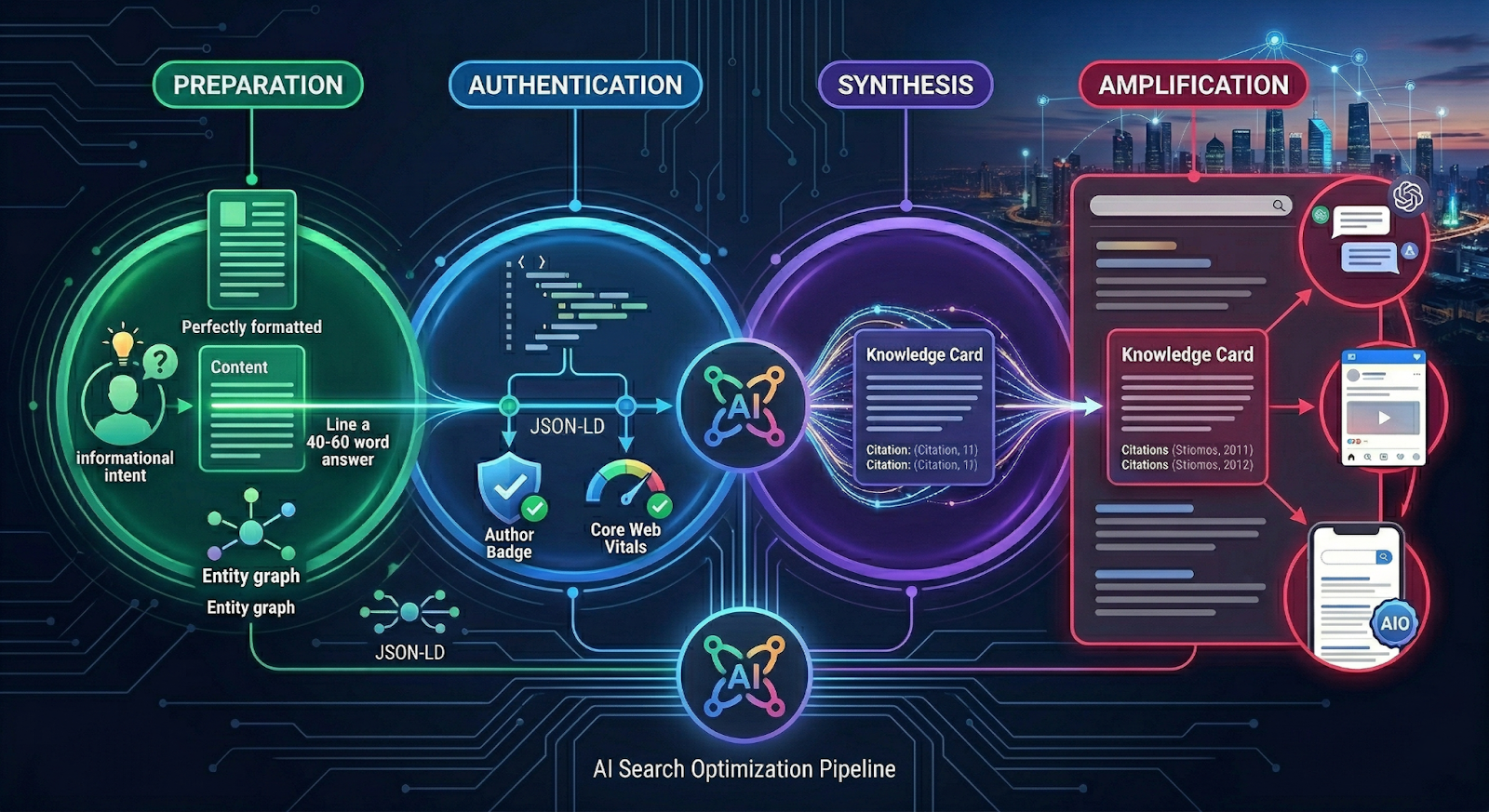
Understanding how to show up in AI overviews SEO has become critical, as statistics show that AI overviews appear for almost 55% of all Google searches. Yet here’s what most marketers miss: research shows that only 8% of users click on links when presented with an overview.
This shift changes everything about how we approach ai seo. Learning how to rank in ai overviews and optimize for ai overviews isn’t optional anymore. Important to realize, 84.72% of AI overviews link to at least one domain that also appears in Google’s top 10 organic search results.
In this guide, we’ll walk you through proven strategies for google ai overview optimization and show you exactly how to position your content in ai generated search results.
Understanding AI Overviews and Why They Matter
What Are Google AI Overviews
Google AI Overviews are AI-generated summaries that appear at the top of search results, synthesizing information from multiple credible sources rather than pulling from a single webpage. Launched officially in May 2024, these overviews now appear in over 120 countries and territories, marking a significant evolution from traditional search results.
The system analyzes search queries and generates related sub-queries to build comprehensive responses. Google’s AI evaluates content at the passage level, selecting specific chunks of information to create unified answers. As of March 2025, 13.14% of all queries triggered an AI overview, up from 6.49% in January 2025, with 88% of those queries being informational.
How AI Overviews Changed Search Results
AI overviews fundamentally altered how information appears on search pages. The top-ranking page experiences a 34.5% drop in click-through rates compared to similar results without AI features. Research indicates that 75% of queries now get answered without users leaving Google, creating what industry experts call a shift from search engine to answer engine.
In contrast to traditional results, our AI experiences represent an evolution to meet shifting user needs. People ask new and more complex questions, receiving consolidated answers before seeing standard listings. This satisfies intent without requiring site visits, particularly for informational searches.
Why Ranking in AI Overviews Matters for Your Business
Appearing in AI overviews provides enhanced credibility and brand exposure at the top of search results. Companies in the top quartile for web presence average 169 AI Overview appearances, compared to just 0.3 mentions for brands in the bottom 50%. This creates significant competitive advantage.
Specifically, when people click to a website from search results pages with AI Overviews, these clicks are higher quality, where users are more likely to spend more time on the site. Your content becomes a vetted source, establishing authority even when direct clicks decline.
How To Rank In AI Overviews: Essential SEO Strategies
Securing visibility in AI overviews requires a strategic shift from traditional optimization tactics. Research confirms that 92.36% of AI-generated answers link to at least one domain ranking in the organic top 10, while 63.19% pull information directly from pages in those positions. These findings establish a clear foundation: ranking on page one remains the gateway to AI overview inclusion.
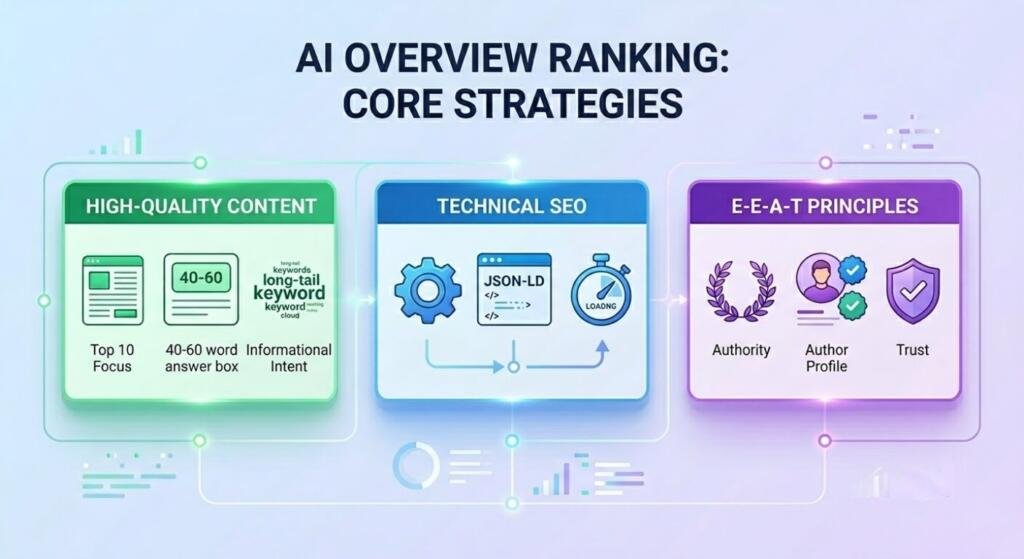
Focus on High-Quality Content That Ranks on Page 1
Achieving first-page rankings creates the primary pathway for AI overview citations. Our analysis shows that 52% of AI overview sources come from the top 10 search results. Focus on creating content that provides substantial value beyond what competitors offer. Google’s AI systems prioritize pages demonstrating depth, accuracy, and original insights rather than surface-level information.
Target Informational and Long-Tail Keywords
AI overviews appear for informational intent keywords 99.2% of the time, with 96.5% of links displaying purely informational intent. Queries containing 8+ words trigger AI overviews 7 times more frequently than shorter queries. Target specific, conversational phrases like “how to improve core web vitals for SEO in 2025” instead of broad single-word terms.
Match User Search Intent Precisely
Search intent determines which content types rank, not keywords alone. Content misaligned with user expectations gets filtered regardless of optimization quality. Informational queries require guides and explanations, while commercial intent demands comparisons and reviews. Analyze the SERP to identify what Google rewards for each query type.
Optimize for Question-Based Queries
Question keywords align with how users naturally search and how AI systems interpret queries. Structure content with question-based headings followed by direct answers. Use the bottom line up front principle, providing immediate responses before expanding with details. This format increases featured snippet and AI overview eligibility significantly.
Apply E-E-A-T Principles to Build Authority
Experience, expertise, authoritativeness, and trustworthiness directly influence AI citation decisions. Demonstrate first-hand experience through case studies and original research. Include author credentials, cite authoritative sources, and maintain content accuracy. AI models favor sources with clear subject matter expertise and verifiable claims over generic content.
Technical Steps to Optimize For AI Overviews
Beyond strategic content decisions, technical infrastructure determines whether AI systems can access and parse your information effectively. Google states that pages must meet technical requirements for search so systems can find, crawl, index, and consider them for AI formats.
Use Schema Markup and Structured Data
Schema markup provides machine-readable context that helps AI systems classify and understand content more reliably. Structured data using Schema.org vocabularies signals page content explicitly to search crawlers. Implement JSON-LD format in your page’s head section, as Google recommends this approach for flexibility and easier management. Focus on relevant schema types like Article, Organization, and FAQ Page that match your actual content.
Improve Site Crawlability and Loading Speed
Organize internal linking to provide clear, logical paths for crawlers, keeping important pages within a few clicks. Remove outdated or underperforming content that consumes crawl budget. Server response time should stay under 200ms. Use a content delivery network to cache web content closer to users, reducing data transfer distance.
Implement FAQ and HowTo Schema
FAQ Page schema feeds AI perfectly formatted question-answer pairs, making content highly likely to appear in AI-generated responses. How To schema breaks processes into numbered steps that AI can extract directly. Both schema types improve E-E-A-T by demonstrating subject expertise. Validate markup using Google’s Rich Results Test to ensure error-free implementation.
Optimize Core Web Vitals
Core Web Vitals measure loading performance, interactivity, and visual stability. Target Largest Contentful Paint under 2.5 seconds, Interaction to Next Paint under 200 milliseconds [261], and Cumulative Layout Shift under 0.1 [261]. These metrics directly influence search rankings and user experience.
Add Clear, Direct Answers in Your Content
Place concise answers within the first 100-200 words of content, using 40-60 word responses that address the main question. Structure text with short paragraphs under 120 words, bullet points, and clear headings. Front-loading answers makes AI extraction easier while serving user needs immediately.
Advanced Tactics for AI Generated Search Results
Mastering technical fundamentals sets the foundation, but advanced optimization tactics separate visible brands from invisible ones in AI-generated search results. These strategies address how AI systems interpret meaning, structure, and multimedia elements.
Leverage Semantic SEO and Entity Optimization
Semantic SEO focuses on topics and entities rather than isolated keywords. AI systems analyze relationships between concepts, people, places, and objects to understand content contextually. Build content clusters linking pillar pages to related subtopics, reinforcing topical authority. Use descriptive anchor text for internal links to strengthen semantic connections between pages.
Create AI-Friendly Content Structure
LLMs interpret content through attention mechanisms that analyze information order, concept hierarchy, and formatting cues. Structure each paragraph around one clear idea, keeping length under 120 words. Use H2 and H3 tags properly nested to establish logical flow. Signal structure with phrases like “step 1,” “in summary,” and “key takeaway” to help AI identify passage roles and extract relevant information.
Use Visuals and Rich Media Effectively
Multimodal search now processes text, images, and video simultaneously. Add descriptive alt text to every visual so AI systems can interpret content accurately. Include high-quality images, charts, and videos that explain complex concepts. Optimize image files for fast loading using modern formats like WebP. Provide captions and transcripts to make multimedia accessible and machine-readable.
Monitor Already-Ranking Content for Updates
Research shows 85% of AI Overview citations were published in the last two years, with 44% from 2025 alone. Focus updates on money pages, high-performing blog posts, and pages ranking on page two. Regular content refreshes maintain accuracy and signal trustworthiness to AI systems evaluating source credibility.
Future-Proofing Your Strategy with Pixel AI Marketing
The search landscape is shifting toward “Search Everywhere Optimization,” where brand discovery happens across AI engines like Gemini and Perplexity, social platforms, and traditional results. By late 2026, fragmented search behavior means your business must be visible wherever audiences ask questions. Success now requires a digital marketing agency that understands how AI models prioritize brand mentions and high-authority citations over traditional backlinks. As third-party cookies vanish and “Agentic AI” begins managing end-to-end campaigns, technical excellence is no longer a luxury—it is an operational baseline for survival.
Pixel AI Marketing is the professional SEO agency specifically built to navigate this AI-driven evolution. We bridge the gap between traditional search excellence and the new world of AI Overviews, ensuring your brand isn’t just indexed, but recommended by generative engines. Our team specializes in semantic SEO, entity-based optimization, and privacy-focused data strategies that turn the complexity of AI into your greatest competitive advantage. Whether you are looking to dominate AI-generated search results or automate your growth with agentic systems, we provide the strategic foresight you need to lead. Don’t let your brand get left behind in the “blue link” era—contact Pixel AI Marketing today for a comprehensive AI Opportunity Audit and secure your spot at the top of the future SERP.
FAQs
Q1. What’s the most important factor for appearing in Google AI Overviews?
Ranking on the first page of Google search results is the primary requirement. Research shows that 92.36% of AI-generated answers link to at least one domain ranking in the organic top 10, and 52% of AI overview sources come from the top 10 search results. Without strong traditional SEO performance, your chances of appearing in AI overviews are minimal.
Q2. Do I need to write content differently for AI Overviews compared to regular SEO?
While the fundamentals remain the same, you should structure content to be more easily parsed by AI systems. This means leading with concise 40-60 word answers, using clear headings and subheadings, keeping paragraphs under 120 words, and formatting information with bullet points. The goal is making your content the best answer source, not just the best search result.
Q3. Does adding schema markup actually help with AI Overview visibility?
Yes, schema markup provides machine-readable context that helps AI systems understand and classify your content more effectively. Implementing FAQ Page, How To, and Article schema using JSON-LD format makes it easier for AI to extract relevant information. Schema markup signals your content structure explicitly to search crawlers, improving your chances of being cited.
Q4. What types of keywords trigger AI Overviews most often?
AI Overviews appear for informational intent keywords 99.2% of the time, particularly for long-tail, conversational queries. Questions containing 8 or more words trigger AI overviews 7 times more frequently than shorter queries. Target natural language phrases like “how to” or “what’s the best way to” rather than single-word keywords.
Q5. Will appearing in AI Overviews hurt my website traffic?
While the top-ranking page experiences a 34.5% drop in click-through rates when AI Overviews appear, the clicks you do receive are higher quality. Users who click through from AI Overview results tend to spend more time on your site. Additionally, appearing in AI Overviews provides enhanced credibility and brand exposure at the top of search results, establishing your authority even when direct clicks decline.
